The Complete Guide to Custom Medical Scrubs: Embroidery, Personalization & Ordering
 Posted By Custom Ink Staff —
The Custom Ink Staff is a team of design enthusiasts and promo product experts dedicated to bringing your ideas to life. From screen printing secrets to the latest trends in custom gear, we draw on decades of collective experience to help you create something unforgettable.
SHARE:


Dress code in the healthcare space matters a lot. Role confusion creates measurable anxiety when patients cannot identify their caregivers at a glance. According to a study at Geisinger Medical Center, 95% of patients rated solid, standardized scrubs as the most professional choice for healthcare workers. For clinic administrators ordering at scale and individual nurses personalizing their own gear, custom embroidered scrubs solve that identity crisis with professional, personalized branding.
This comprehensive guide serves as your authoritative hub for custom medical scrubs. We break down everything you need to know: what customization options are available, which fabrics hold up best to industrial laundering, how embroidery actually works on stretch medical fabrics, and how to run a facility-wide personalized scrub program without any of the usual administrative headaches.
In This Article
- What Are Custom Medical Scrubs?
- Personalization & Customization Options
- Best Materials for Durable Medical Scrubs
- Fit Options: Standard, Petite, Plus & Tall
- Custom Scrubs for Different Healthcare Roles
- Embroidery for Medical Scrubs: Technical Specs
- Medical Apparel with Custom Logo: Branding Your Practice
- How to Get Medical Scrubs Personalized
- Frequently Asked Questions
Shop Custom Embroidered Scrubs
Key Takeaways
- Fabric composition determines everything: Scrubs with 5%+ elastane (like the Onna Limitless at 6% or Cherokee Revolution at 2% spandex) provide the four-way stretch that twelve-hour shifts demand, but those same fabrics require cut-away embroidery backing to prevent puckering after industrial washing.
- 65% of uniform buyers now require smart fabric technology: According to our 2026 Swag Trends Survey, moisture-wicking and elastane blends are no longer a premium upgrade; they’re the baseline expectation for daily-wear medical uniforms.
- Embroidery placement is exact, not approximate. Left chest logos must center 7–9 inches below the left shoulder seam, 3.5–5 inches from the center placket, with a maximum width of 3–4 inches to avoid armpit wrap distortion.
What Are Custom Medical Scrubs?

Custom medical scrubs are standard healthcare garments personalized with institutional branding, practitioner identification, or both. The “custom” part encompasses any combination of logo embroidery, name and title embroidery, and department color-coding. What separates a quality custom scrub from a basic uniform is the combination of the underlying garment’s textile engineering (stretch fabrics, antimicrobial finishes, moisture management) and the decoration method that won’t degrade those properties over hundreds of industrial wash cycles.
The promotional products industry, which includes the full spectrum of workwear and uniforms, hit a record $27.7 billion in 2025. In healthcare specifically, the driver is function: a scrub that looks good but doesn’t perform in the clinical environment doesn’t serve either the facility’s brand or the practitioner wearing it.
Personalization & Customization Options for Scrubs

The options for customizing scrubs fall into three categories. Most orders combine at least two of them.
| Customization Type | What It Includes | Best For |
|---|---|---|
| Logo Embroidery | Clinic or hospital logo in thread, left chest standard placement | Facilities building a unified, branded team appearance |
| Name + Title | Practitioner name on line 1. Credential (RN, MD, DDS) + department on line 2 | Individual practitioners and any facility prioritizing patient wayfinding |
| Department Color-Coding | Different scrub colors assigned by role: navy for nursing, ceil blue for imaging, etc. | Larger facilities where patient identification across departments is a safety concern |
Embroidery is the standard decoration method for medical scrubs because the textured thread finish withstands repeated high-heat laundering without fading or cracking, a hard requirement in clinical environments. Screen printing works for some scrub applications, but heat and chemical exposure in hospital laundering degrades printed ink significantly faster than embroidered thread.
Standard name and title protocol places the practitioner’s name on the first line, credential and department on the second. This specific configuration (e.g. Dr. Sarah Marsh / MD, Pediatrics) gives patients the full picture without cluttering the garment. Block fonts read most clearly at the 3-to-4-inch embroidery width used on most scrub tops.

“Custom Ink is always part of our celebration. The Nurses Week is not complete without us wearing a shirt that made for us by this company. This shirt strengthens our unity and teamwork.”
Best Materials for Durable Medical Scrubs
According to our 2026 Swag Trends Survey, 65% of daily-wear uniform buyers rate smart fabric technologies, specifically moisture-wicking and elastane blends, as very or extremely important.
For medical scrubs, that translates to specific fabric compositions that determine how a garment performs after 200+ industrial wash cycles. The table below maps real manufacturer specs to clinical use cases.
| Style | Fabric Composition | Weight / Size Range | Key Technology | Best For |
|---|---|---|---|---|
| Cherokee Workwear Revolution V-Neck | 78% Polyester, 20% Rayon, 2% Spandex Twill | Midweight; XXS–5XL | PROTX2 antimicrobial + moisture-wicking; instrument loop, bungee ID loop | Nurses, surgical teams; high-wash environments |
| Onna Limitless Stretch V-Neck | 42% Polyester, 33% Recycled Polyester, 19% Viscose, 6% Elastane | Midweight 210gsm (~6.2 oz); XS–4XL | Four-way stretch; sustainable recycled content; highly breathable | High-mobility roles; facilities with sustainability commitments |
| Skechers by Barco Reliance | 54% Polyester, 40% Recycled Polyester, 6% Spandex | Midweight; XXS–5XL | Arcgreen sustainable fabric (7 recycled bottles per garment); soil release; 4-way stretch | Dental and outpatient; fluid-exposure environments |
| Wink WorkFlex Stretch V-Neck | 65% Polyester, 35% Cotton | Lightweight; 2XS–5XL | Mechanical stretch; poly/cotton durability; side vents for mobility | Budget-conscious programs; mixed-role outfitting |
One note on embroidery compatibility: higher spandex content (5%+) requires a medium-weight cut-away backing stabilizer during embroidery production.
The Onna Limitless at 6% elastane and the Skechers Reliance at 6% spandex both fall into this category. Cut-away stabilizers, unlike tear-away versions, leave permanent structural support in the fabric, which is what prevents logo distortion after industrial washing. At Custom Ink, we handle this automatically on every order.
Fit Options: Standard, Petite, Plus & Tall

A unified clinic appearance fails if the garments don’t fit. Ill-fitting scrubs create more than an aesthetic problem. Dragging hems are a tripping and contamination hazard, and tops that ride up during patient transfers expose skin in sterile environments. The size categories differ at the garment level in ways that matter clinically:
- Standard: Straight fit across chest and body; typical inseam 28.5 inches (women) and 31 inches (men); covers XXS–5XL in most premium lines like the Cherokee Revolution and Onna Limitless.
- Petite: Not simply a hemmed standard. True petite options like the Jaanuu Women’s Petite Silex Knit-Waist Jogger Scrub Pant feature adjusted proportions: 26-inch inseam, higher knee breaks, and repositioned pockets that maintain ergonomic placement rather than dropping awkwardly from a shortened leg.
- Tall: Extended inseams of 34–36 inches for staff over 6’0″; ensures tops stay tucked during patient lifts and transfers, where exposure is a real risk.
- Plus sizes: Premium lines like Onna Limitless run to 4XL; Cherokee Revolution extends to 5XL. The key difference from standard sizing is proportional shoulder and torso adjustment, the adjustment goes beyond added width.
For bulk facility orders, we recommend collecting exact size and fit preference data before placing. Our group order feature lets each staff member specify their own sizing. This eliminates the most common administrative headache in uniform programs: exchanges and re-orders from sizing errors.
Custom Scrubs for Different Healthcare Roles
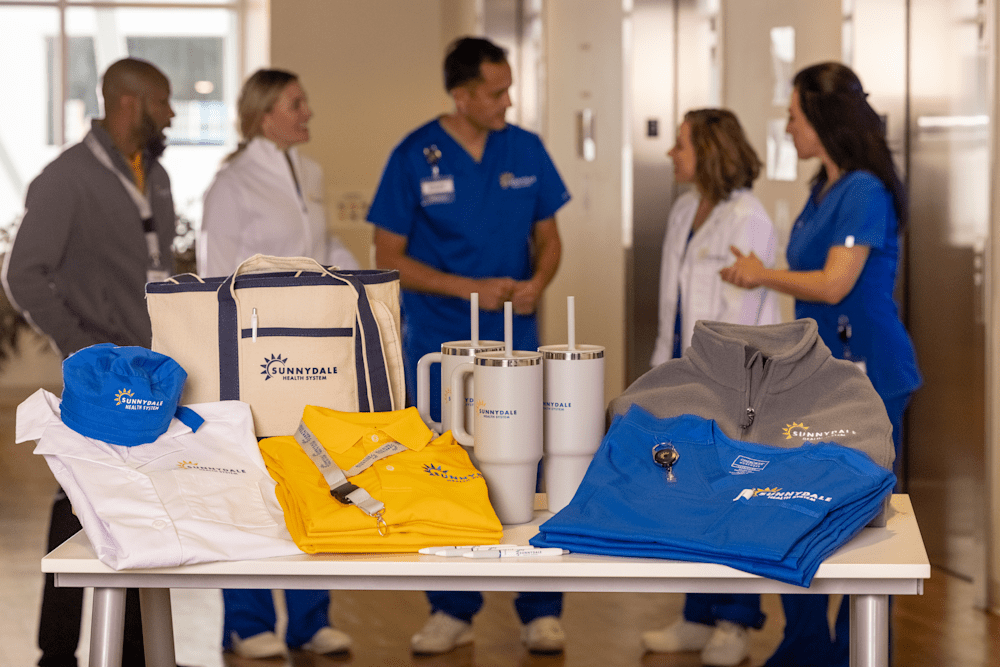
The best scrubs for a nurse running between rooms for 12 hours are not the same scrubs that work best for a dental hygienist leaning over patients all day. Here’s what actually matters by role.
Nursing Professionals
Nurses need pocket architecture and four-way stretch above all else. The best custom scrubs for nurses prioritize jogger-style pants with 5–6 specialized pockets, including dedicated phone compartments and instrument loops, and tops with at least 5% elastane for patient transfers and bending. The Onna Limitless (6% elastane, 210gsm) and Cherokee Revolution (2% spandex with PROTX2 antimicrobial) are the two most ordered styles in our nursing category.
Physicians and Surgeons
Physicians typically pair embroidered V-neck scrub tops with lab coats for consults, then shift to performance scrubs for procedures. In surgical environments, scrubs with Certainty or PROTX2 antimicrobial technology inhibit odor-causing bacteria during extended shifts. This is a practical concern, not a marketing one.
Dental Professionals
Dental practitioners operate in close proximity and face regular aerosolized fluid exposure. Mock wrap necklines provide better coverage when bending forward than standard V-necks. Fabrics with soil release finishes, like the Skechers by Barco Reliance, prevent dental compound staining from setting into the fabric.
Veterinary Staff
Vet practices need abrasion-resistant fabrics that shed animal hair rather than trapping it. High-polyester blends like the Cherokee Infinity (95% polyester poplin) allow fur to slide off the surface. Dolman sleeves give the unrestricted shoulder movement needed when lifting animals onto exam tables. For more on outfitting vet teams, see our guide to custom veterinary equipment.

“After six grueling semesters of clinical, class and exams we have been transformed from students to nurses! We created this shirt to celebrate our accomplishment, because we earned our degrees (RN, BSN) it wasn’t given to us. Thank you CustomInk for helping us create an awesome shirt! Everybody I talked to was stellar and I would work with you all again!!”
Embroidery for Medical Scrubs: Technical Specs

Most embroidery guides skip the production details that actually determine whether your logo looks sharp after 50 washes or starts puckering after 10. Here’s what happens in the production process, and why it matters for scrubs specifically.
Stabilizer Requirements for Stretch Fabrics
Modern medical fabrics containing elastane, spandex, or viscose require a medium-weight cut-away backing stabilizer (2.5–3.0 oz.) during embroidery. Tear-away backing, which is standard for woven fabrics, doesn’t provide permanent structural support to stretch materials. Without cut-away backing, the embroidered logo will warp and collapse after repeated cycles in industrial washing machines. This is the single most common reason embroidery on scrubs fails prematurely, and it’s entirely preventable with the right backing.
Every order we produce uses the correct backing for the specific fabric. As our production team puts it: the backing decision happens before the first stitch, and getting it wrong means the garment fails in the laundry, not on the floor.
Placement Standards for Clinical Apparel
- Left chest placement: The standard for medical identification. The absolute center of the embroidery should be 7–9 inches down from the left shoulder seam, and 3.5–5 inches from the center placket (varying by garment size). This positions the logo directly in the patient’s line of sight during consultations.
- Logo width: Keep between 3.0–4.0 inches. Designs exceeding 4 inches risk wrapping toward the armpit on smaller sizes, distorting the logo and making text illegible.
- Secondary placement: Right chest is standard for name and title embroidery when a logo occupies the left chest. Sleeve placement is used for department or specialty designations.
- Solid-color garments only: Embroidery thread does not read cleanly on patterned or printed fabrics. This is why custom embroidered scrubs are always ordered on solid-color styles.
Medical Apparel with Custom Logo: Branding Your Practice

The case for medical apparel with custom logo goes beyond aesthetics. Research from Geisinger Medical Center found that 95% of patients associate standardized, solid-colored staff uniforms with higher professional competence. Color-by-discipline programs, where nursing wears navy, imaging wears ceil blue, and administration wears pewter, improve patient wayfinding and reduce the role-confusion anxiety that’s documented across inpatient settings.
The internal case is equally strong. Our 2026 Swag Trends Survey found that 91% of employees feel more valued when they receive custom gear from a recognized retail brand. Providing staff with premium lines like Cherokee, Skechers by Barco, or Onna rather than private-label generics communicates that the facility pays attention to quality. And according to the Company Swag Survey, more than 75% of employees say high-quality branded gear increases their likelihood of staying with an organization.
How to Get Medical Scrubs Personalized
Managing a facility-wide scrub program across multiple departments, sizes, and name-and-title combinations is the kind of administrative task that expands quickly once you start collecting data. The workflow below keeps it from becoming a bottleneck. Individual practitioners ordering for themselves can skip steps 1–2.
- Define your clinical requirements. Determine whether the environment demands high-stretch elastane blends (surgical, nursing), soil-release finishes (dental, procedural), or antimicrobial technology (high-acuity wards). Different departments may need different fabrics under one logo.
- Establish your color and brand standards. Select garment colors by department. Gather your logo in vector format (.EPS, .SVG, or .AI). Vector files ensure clean digitization to a stitch file without pixelation. If you only have a raster file, our design experts will prepare it for embroidery at no extra cost.
- Collect individual sizing and name data. For name and title embroidery across a full staff, the most efficient approach is a spreadsheet: name, credential, department, size, and fit preference per person. Our group order feature lets each person submit their own sizing, eliminating the admin work of chasing down that information manually.
- Preview and approve. Our Design Lab shows exact placement of your logo and text on the specific garment before production begins. For embroidery, our team reviews every file for stitch density and thread color matching before it goes to production.
- Place your order. Configure your custom embroidered scrubs with exact sizing distributions, logo placement, and name/title data. Orders arrive at your door within two weeks with our free standard shipping. Rush options are available when timelines are tight. See delivery options for current turnaround by product type.
Shop Custom Embroidered Scrubs
Frequently Asked Questions
Q: What are the best scrubs for embroidery?
Midweight scrubs with a smooth surface work best for embroidery. The Cherokee Workwear Revolution (78% polyester, 20% rayon, 2% spandex) and Wink WorkFlex (65% polyester, 35% cotton) both digitize cleanly. High-spandex fabrics like the Onna Limitless (6% elastane) embroider well but require cut-away backing stabilizer, not tear-away, to prevent post-wash puckering. Avoid patterned or printed fabrics; embroidery thread reads most cleanly on solid colors.
Q: What customization options are available for medical scrubs?
For custom medical scrubs, options include: left-chest logo embroidery, name and title embroidery (name on line 1, credential + department on line 2), sleeve placement for specialty designations, and garment color selection for department color-coding. Embroidery is standard for clinical apparel because it withstands high-heat industrial laundering without fading or cracking. All options are available through our Design Lab, and our design experts can help configure any combination.
Q: How do I order custom petite fit scrubs for my staff?
Petite scrubs are available in several styles we carry, including the Jaanuu Women’s Petite Silex Knit-Waist Jogger Scrub Pants. True petite options feature a 26-inch inseam and repositioned pockets, a genuine proportion adjustment, not a hemmed standard length. When placing a facility order, include “petite” as a fit option in your sizing data collection. Our group order feature lets individuals specify petite, standard, or tall fit, so you collect the right data upfront and avoid exchange orders.
Q: How long does it take to get custom embroidered medical scrubs?
Custom embroidered scrubs arrive within two weeks with our free standard shipping. If you’re working with a tighter timeline, such as a new facility opening, a class graduation, or a staff onboarding cohort, rush options are available for an additional charge. See our delivery options page for current turnaround times by product type. For large facility orders with variable name and title data, we recommend building in extra lead time to allow for file review and approval.
Q: Can I order just a few custom scrubs, or is there a minimum quantity?
Most embroidered custom scrubs require a minimum of 6 per style. This is typical for embroidery production across the industry. If you need fewer than 6 of a specific style, contact our team. We can often accommodate smaller quantities or help you find a configuration that meets your needs. For larger facility programs with hundreds of staff, bulk pricing applies automatically as quantity increases.
Q: Do I need to provide a vector file for my logo?
Vector files (.EPS, .SVG, .AI) produce the cleanest embroidery results because they scale without pixelation during the digitization process. That said, we can work with any file format. If you upload a raster file (JPG, PNG), our design experts will prepare it for embroidery production at no extra cost. We review every file before it goes into production.
Q: Can different team members get different customization on the same order?
Yes. Our platform handles variable data orders, meaning each person on your team can have their own name, title, and department embroidered on identically branded scrubs within a single order. You can also mix scrub styles, sizes, and fit options (standard, petite, tall) across one order. This is how most clinic and hospital uniform programs work in practice. See our group ordering options for the full workflow.

The Custom Ink Staff is a team of design enthusiasts and promo product experts dedicated to bringing your ideas to life. From screen printing secrets to the latest trends in custom gear, we draw on decades of collective experience to help you create something unforgettable.