Custom Car Magnets: The Spec-to-Street Guide for Businesses and Events
 Posted By Custom Ink Staff —
The Custom Ink Staff is a team of design enthusiasts and promo product experts dedicated to bringing your ideas to life. From screen printing secrets to the latest trends in custom gear, we draw on decades of collective experience to help you create something unforgettable.
SHARE:



According to the Outdoor Advertising Association of America (OAAA), a single vehicle generates between 30,000 and 70,000 advertising impressions per day simply by driving normal routes. For a service business whose truck is already on the road, that’s free brand exposure. A set of custom car magnets turns those miles into a running ad campaign, at a fraction of what digital advertising costs per impression, and with zero ongoing spend after the initial order.
The same logic applies to a school booster club decorating parent vehicles before a big game, a real estate agent advertising open houses, or anyone who wants their car to say something without making a permanent commitment.
The challenge is that most buyers order on price and discover the problems later: a magnet that peels off at highway speeds, pockmarks in the door paint, or a magnet that has permanently curled from sitting in the trunk. This guide covers the material science behind why those failures happen and how to avoid them, so you order once and get it right.
In This Article
- Magnet Thickness: Why 30 Mil Outperforms 45 Mil on Most Vehicles
- Vehicle Compatibility: Which Surfaces Work and Which Don’t
- Design Rules for a Moving Vehicle
- Use Cases: Business, Events, and Personal
- Care and Maintenance: Preventing the Common Failures
- How to Order
- Frequently Asked Questions
Key Takeaways
- 30 mil is the correct magnet thickness for most passenger vehicles: It provides approximately 90 to 100 lbs of pull force per square foot, holds securely at highway speeds, and stays flexible enough to conform to door panels without bridging, which is the physical mechanism behind high-speed detachment.
- Magnets only adhere to ferrous metal: Steel and iron hold a magnet. Modern aluminum doors, fiberglass bumpers, and doors repaired with polyester filler do not. Check your vehicle before ordering.
- 44% of buyers prioritize quality over price on non-apparel branded items: Per our 2026 Swag Trends Survey, “Longevity/Quality” is the top factor. A budget magnet that scratches your paint or blows off at 65 mph ends up costing more than the sign was worth.
Magnet Thickness: Why 30 Mil Outperforms 45 Mil on Most Vehicles
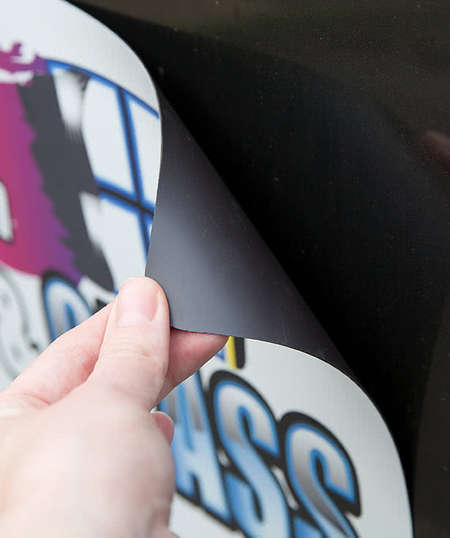
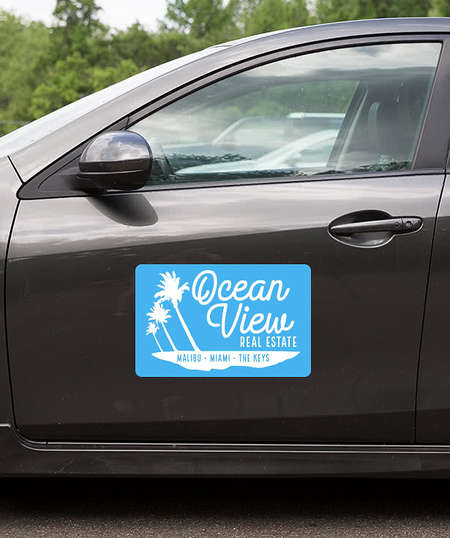
Magnet thickness is measured in “mils,” or thousandths of an inch. A standard refrigerator magnet runs about 20 mil. Vehicle door magnets start at 30 mil and go up to 45 mil or heavier for specialty applications. The instinct to buy thicker is understandable: more magnet, more hold. The physics does not work that way on curved vehicle surfaces.
A 45 mil magnet is stiffer. On a flat surface, that stiffness means better contact. On the gently curved door panels of most sedans, SUVs, and pickup trucks, a stiff magnet bridges over the curve rather than conforming to it. That bridging creates air gaps at the edges where wind gets under the sign at highway speeds, and the lift force at 65 mph is enough to peel it off entirely.
A 30 mil magnet (0.030 inches thick) is flexible enough to conform to standard vehicle door curvature, maintains full-surface contact, and delivers approximately 90 to 100 lbs of pull strength per square foot, more than sufficient to hold the sign at normal driving speeds.
| Thickness | Flexibility | Pull Strength (approx.) | Best Surface Type | Highway Speed Performance | Best For |
|---|---|---|---|---|---|
| 20 mil | Very flexible | ~45–60 lbs/sq ft | Any flat surface | Poor (insufficient hold) | Refrigerator magnets, indoor use only |
| 30 mil | Flexible | ~90–100 lbs/sq ft | Standard curved door panels | Good (maintains contact on curves) | Passenger cars, SUVs, pickup trucks, vans |
| 35 mil | Semi-rigid | ~110–120 lbs/sq ft | Flatter panel sections | Good on flat, risky on curved | Larger flat doors on full-size vans, box trucks |
| 45 mil+ | Rigid | ~130+ lbs/sq ft | Flat metal only | Risk of edge-lift on any curved panel | Industrial equipment, flat-panel applications |
Our standard car door magnets are manufactured at 30 mil, sized for door panels across a range of standard passenger vehicles and light commercial vehicles. The printed vinyl face is laminated with a UV-resistant clear coat that protects against fading, cracking, and surface abrasion without adding stiffness to the magnet base.
Vehicle Compatibility: Which Surfaces Work and Which Don’t

Magnetic sheeting adheres through attraction to ferrous metals, specifically steel and iron. Many newer vehicles use aluminum body panels, which are not magnetic. A magnet placed on an aluminum door will fall off immediately. Before ordering, run a standard kitchen refrigerator magnet across the area of the vehicle where you plan to mount your sign. If it holds firmly, the panel is ferrous and will work. If it falls or barely holds, the panel is likely aluminum or composite.
| Vehicle Panel Type | Magnet Holds? | Common Examples | Notes |
|---|---|---|---|
| Steel door panels | Yes | Most domestic trucks and vans, older sedans, commercial vehicles | Ideal surface; use 30 mil magnet |
| Aluminum door panels | No | Ford F-150 (2015+), Audi, BMW, Mercedes, many newer sedans | Magnet will not hold; consider vinyl decals instead |
| Fiberglass / plastic panels | No | Bumpers, fender flares, some specialty vehicles | Not magnetic; no adhesion possible |
| Body filler / Bondo-repaired panels | Reduced or no hold | Any door panel repaired with polyester filler | Filler disrupts magnetic contact; test with a fridge magnet first |
| Freshly painted panels | Avoid for 90 days | Recently repainted doors, custom paint jobs | New paint needs to fully cure before magnet application |
If you drive a vehicle with a mix of steel and aluminum panels (which is common on modern pickup trucks), the cab doors are often still steel while the bed panels are aluminum. Test each surface individually. Many service business owners run a steel-door test when purchasing a new work vehicle specifically to preserve magnet usability.
Design Rules for a Moving Vehicle
A car door magnet is seen for approximately two to three seconds by drivers and pedestrians at normal street speeds. That viewing window is shorter than a yard sign and requires the same discipline: fewer words, higher contrast, larger type.
- Maximum 6 words or 30 characters. A phone number counts as one chunk. “Smith Plumbing | (555) 123-4567” is two elements. That is enough for a door magnet. Adding a website URL, tagline, and license number makes the sign unreadable from a moving car.
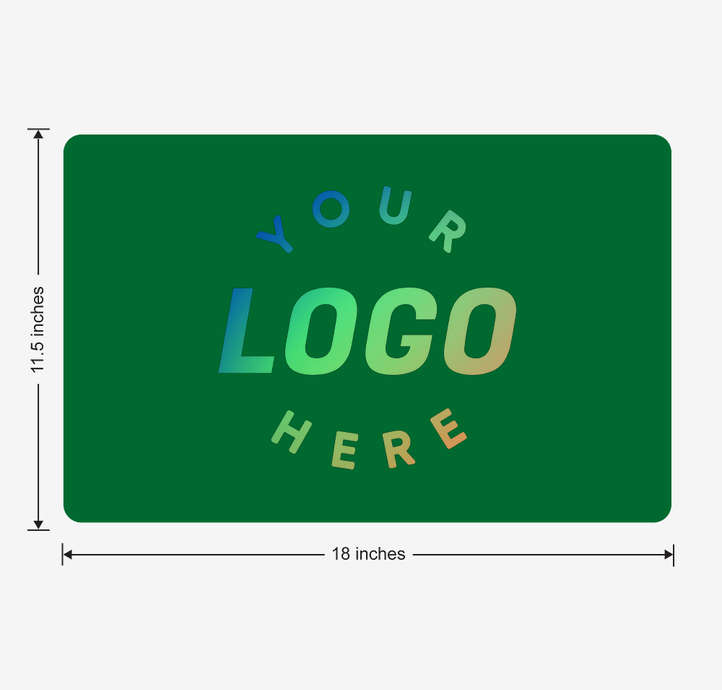
- Minimum 2-inch headline letters. For a standard 18″ x 11.5″ door magnet viewed at 15 to 25 feet, business name text needs to be at least 2 inches tall. Phone numbers should be at minimum 1.5 inches. Anything smaller reads fine when you are standing next to the car and not at all when you are driving past it.
- 70% contrast ratio minimum. High-contrast combinations for vehicle magnets: white on navy, black on white, white on red, black on yellow. Low-contrast combinations that fail on vehicles: pale blue on white, gray on silver, yellow on light backgrounds.
- Sans-serif fonts only. Script, italic, and decorative typefaces lose legibility at angle and speed. Use Helvetica, Arial, Franklin Gothic, or similar clean, neutral typefaces for any text that needs to be read from another vehicle.
- Minimum 300 DPI at print size. Vector formats (PDF, EPS, SVG) are preferred. If uploading a raster image, minimum resolution for an 18″ x 11.5″ magnet is 5400 x 3450 pixels at 300 DPI. Our design team reviews every file before production and flags resolution issues before your order goes to print.
- 0.25-inch safe zone inside the trim edge. Keep all critical content (phone numbers, URLs, logos) at least 0.25 inches from the edge. Magnets are cut with a small tolerance that can clip edge content.

Use Cases: Business, Events, and Personal
Service Businesses and Fleet Advertising
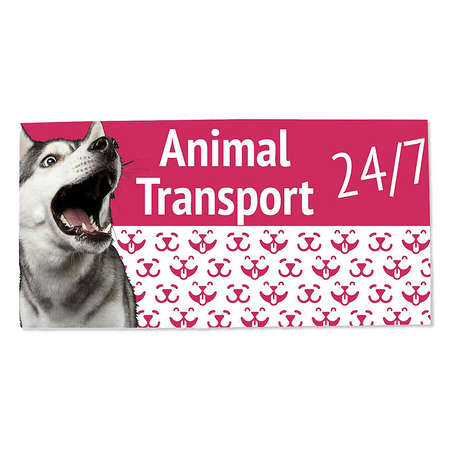
The single most cost-effective use of a car magnet is a local service business whose owner or technicians drive their personal or company vehicles between job sites. Every parked vehicle at a job is visible to every neighbor on that street. Magnets solve the specific problem that full vehicle wraps create: you cannot put a permanent wrap on a personally-owned vehicle your employee will eventually replace or sell. Magnets install in seconds, remove without damaging the paint, and can be swapped between vehicles as your fleet changes.
- Recommended size: 18″ x 11.5″ magnet per door for standard passenger vehicles; consider a 24″ x 12″ magnet for full-size truck doors or cargo van panels where the larger surface allows bigger type
- What to include: Business name, primary service, phone number, and optionally a QR code linking to your booking page. Keep the total to four elements maximum.
- Bulk ordering: If you have three or more vehicles, ordering magnets in sets reduces per-unit cost significantly through our bulk pricing. Two magnets per vehicle (one per door) is the standard setup.

Real Estate Agents
Real estate agents typically drive personal vehicles and cannot permanently brand them. Magnets solve this exactly. A standard 18″ x 11.5″ door magnet with brokerage logo, agent name, and phone number turns the drive between properties into continuous lead-generation. Remove the magnet when using the vehicle personally; reinstall in ten seconds before heading to a showing.
School, Sports, and Fundraising


Booster club and school spirit magnets are among the highest-volume personal use cases for custom car magnets. A set of magnets sold to parents before a playoff run, printed with the team name and mascot, generates community visibility for the school and fundraising revenue for the program. Smaller round magnets (5″ x 5″ or 6″ diameter) work well for this use case and are popular for bumper placement on flat trunk lids.
- Fundraising strategy: Sell individual magnets at $10 to $15 per unit. At typical bulk unit costs, that leaves meaningful margin per magnet. Parents buy them enthusiastically because they can display school spirit without committing to a bumper sticker.
- Recommended size: 5″ round or 6″ x 4″ oval or 9″ x 3″ rectangle for bumper and trunk placement; 12″ x 6″ for door panels if the design calls for more space



Care and Maintenance: Preventing the Common Failures
Most car magnet failures, including paint damage, detachment at speed, and permanent curling, are preventable. The three main failure mechanisms and how to avoid each one:
Paint Damage (Trapped Debris)
Road dust, salt, and grit accumulate between the magnet backing and the door panel surface. When the vehicle moves, those particles act as abrasives and scratch the paint. Prevention is simple: remove the magnet weekly and clean both the vehicle surface and the magnet backing with mild soap and water. Dry both surfaces completely before reapplying. Never let either surface air-dry with visible debris between them.
Magnet Memory (Permanent Curl)
Flexible magnetic sheeting develops a permanent deformation (called magnet memory) when stored in a rolled or folded position. A curled magnet cannot lay flat against a door panel. The curved edges create air gaps that cause edge-lift at speed, and the sign detaches. Always store magnets flat. The best practice is to store them on the inside surface of your vehicle’s metal panel (the back of the trunk lid or a cargo area panel) rather than rolling them into the trunk floor.
Paint Fading Under the Magnet
Direct UV exposure weathers exterior paint over time. A magnet that stays on a door panel for months without removal protects that patch of paint from UV while the surrounding area continues to fade. The result is a visible lighter rectangle on the door when the magnet is eventually removed. Prevention: remove the magnet periodically, particularly on weekends or days when the vehicle sits in direct sun for extended periods. Rotating the magnet between vehicles also eliminates this issue for fleet operators.
| Failure Mode | Cause | Prevention |
|---|---|---|
| Paint scratches or pockmarks | Trapped road grit between magnet and panel | Remove weekly; clean both surfaces with soap and water; dry completely before reapplying |
| Sign detaches at speed | Magnet memory (curl from improper storage) or wrong thickness for curved panel | Store flat; use 30 mil for standard curved doors; test for full-contact seal before driving at highway speeds |
| Paint fading differential | UV weathering of surrounding paint while panel under magnet stays protected | Remove periodically, especially in high-sun seasons; rotate if using on multiple vehicles |
| Magnet bonds to paint in heat | Sustained high heat (direct sun, summer parking) softens the magnetic backing | Remove from vehicle when parked in direct sun for extended periods; never leave on during a car wash |
How to Order Custom Car Magnets
- Confirm your vehicle surface. Run a kitchen refrigerator magnet across the door panel. If it holds, you are good to order. If it falls, your panel is aluminum or composite and will not support a magnetic sign.
- Choose your size. Standard 18″ x 11.5″ magnet covers most passenger car and light truck doors. For full-size truck doors or cargo van panels, consider 24″ x 12“. Smaller round formats (5″ to 6” diameter) work for trunk lids and personal-use magnets.
- Design your magnet. Start in the Design Lab with a template, or upload your existing artwork. Templates are pre-sized for the magnet format with correct bleed areas. Keep your design to six words or fewer at 2-inch-minimum letter height.
- Review and approve your proof. Every order receives a digital proof before production begins. Our design team reviews artwork files and will flag resolution or bleed issues before your sign goes to print.
- Choose your delivery timeline. Orders ship with free standard shipping and arrive within approximately two weeks. Rush options are available for tighter timelines. For fleet orders across multiple vehicles, our custom signs team can coordinate signage and apparel in a single order.
Frequently Asked Questions
Q: Will a car magnet damage my vehicle’s paint?
Not if you maintain it correctly. The risk comes from trapped road debris between the magnet backing and the door panel. Clean both surfaces weekly with mild soap and water, dry them completely, then reapply. Do not leave the magnet on a freshly painted panel (allow 90 days for new paint to cure) and do not apply to vehicle doors that have been repaired with body filler, which can reduce magnetic contact and cause the sign to rub rather than seal cleanly.
Q: What thickness of car magnet should I order?
For standard passenger cars, SUVs, and light pickup trucks, 30 mil (0.030 inches) is the correct choice. It provides approximately 90 to 100 lbs of pull force per square foot, conforms to standard door panel curves, and holds securely at highway speeds. Thicker magnets (35 to 45 mil) are stiffer and can bridge over curved panels, creating edge gaps that cause the sign to detach at speed. Our car magnets are manufactured at 30 mil for this reason.
Q: Will car magnets stick to my vehicle?
Only if the panel is ferrous metal. Aluminum panels, fiberglass bumpers, plastic body panels, and doors heavily repaired with body filler will not hold a magnetic sign. Many modern vehicles use aluminum doors: the Ford F-150 since 2015, most European luxury brands, and many newer sedans. Test with a kitchen refrigerator magnet before ordering. If it holds firmly, your vehicle will work.
Q: Can I order car magnets in bulk for multiple vehicles?
Yes. Per-unit pricing decreases as quantity increases. For fleets of three or more vehicles, ordering at least two magnets per vehicle in a single run produces meaningful savings. Use the quantity selector on the product page to see real-time pricing, or contact our team for a fleet quote.
Q: How do I store car magnets when not in use?
Always store flat. The best option is to stick the magnet to a flat metal surface inside the vehicle when not displayed. The inside of the trunk lid or a rear cargo panel works well. Never roll or fold the magnet. Rolled storage creates permanent magnet memory (a curl deformation) that prevents the sign from lying flat against the door panel, which leads to edge-lift and detachment at highway speeds.
Q: How long do custom car magnets last?
With proper maintenance, our 30 mil car magnets last one to two years. UV-resistant laminate on the printed vinyl face protects the print from fading and surface abrasion without adding stiffness. The limiting factor is usually storage and maintenance habits, not the material itself. Magnets left on the vehicle in direct sun without removal and kept on through car washes will show wear significantly faster than magnets that are removed weekly and stored flat.

The Custom Ink Staff is a team of design enthusiasts and promo product experts dedicated to bringing your ideas to life. From screen printing secrets to the latest trends in custom gear, we draw on decades of collective experience to help you create something unforgettable.