Custom Signs: A Practical Guide to Types, Materials & What Actually Works
 Posted By Custom Ink Staff —
The Custom Ink Staff is a team of design enthusiasts and promo product experts dedicated to bringing your ideas to life. From screen printing secrets to the latest trends in custom gear, we draw on decades of collective experience to help you create something unforgettable.
SHARE:



A FedEx Office “Signs of the Times” survey found that 76% of consumers have walked into a business they had never visited before based solely on its display signs. That single stat says a lot: your signage works before you ever open your mouth.
Whether you are promoting a grand opening, running a political campaign, branding a trade show booth, or advertising your service truck, the right custom signs do more than display your name. They set expectations, build trust, and drive sales.
The challenge is finding the right custom signage that works for your business needs. The sign category covers a wide range of products with very different materials, lifespans, and use cases. A 13 oz scrim vinyl banner that looks perfect at an outdoor festival will not survive three winters on a building exterior. Meanwhile, a 4mm corrugated yard sign that drives real estate traffic is overkill for an indoor trade show booth.
This guide maps out the right sign option for each situation so you order once and get it right.
In This Article
- 5 Sign Types at a Glance
- Vinyl Banners
- Yard Signs & Lawn Signs
- Car Door Magnets
- Feather Flags
- How to Design a Sign That Gets Noticed
- How to Order Custom Signs
- Frequently Asked Questions
Key Takeaways
- 76% of consumers enter a store because of its signage: quality and placement matter more than most business owners realize, according to the FedEx Office “Signs of the Times” survey.
- Material determines longevity: 4mm corrugated polypropylene yard signs last 6 to 12 months outdoors, while 13 oz scrim vinyl banners cover the same range. If you need permanent exterior branding, you need a different substrate entirely.
- 44% of swag buyers rank quality above everything else, per our 2026 Swag Trends Survey, “Longevity/Quality” is the most important factor for non-apparel branded items. A cheap sign that fades in 60 days costs more in the long run.
5 Custom Signage Types at a Glance

Not sure which sign format fits your unique business needs? This table covers the five most common custom sign categories and when and where to use each one.
| Sign Type | Core Material | Standard Spec | Outdoor Lifespan | Best For |
|---|---|---|---|---|
| Vinyl Banners | Scrim-reinforced PVC | 13 oz per sq yard | 6–12 months | Events, trade shows, storefront announcements, grand openings |
| Yard Signs | Corrugated polypropylene | 4mm (0.1875 lbs/sq ft) | 6–12 months | Campaigns, real estate, contractors, community events |
| Car Door Magnets | High-energy magnetic sheeting | 30 mil (0.030 inches) | 1–2 years | Service businesses, fleets, mobile advertising |
| Feather Flags | Polyester fabric | 8 ft standard | 1+ years with storage | Outdoor events, curb appeal, grand openings |
| Stand-Up Banners | Smooth 13 oz blockout vinyl | 30.5″ × 74″ | Indoor use | Trade show booths, lobbies, retail displays |
Vinyl Banners
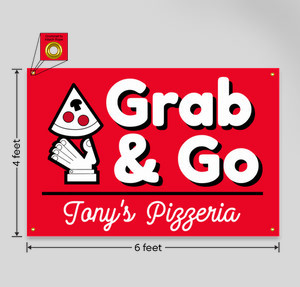
The most versatile sign in the category, vinyl banners work equally well strung between two poles at an outdoor festival, hung from the ceiling at a trade show, or stretched across a storefront for a seasonal promotion. Standard outdoor banners are printed on 13 oz scrim vinyl, a polyester mesh core sandwiched between two layers of PVC. That internal scrim is what gives the banner its tensile strength and prevents stretching under wind load.
For windy locations like chain-link fences at athletic fields or construction site perimeters, mesh vinyl (8 oz) is a better choice. Its perforated structure (typically a 70/30 ratio of printable surface to perforations) lets air pass through and dramatically reduces the risk of tearing at the grommets. If you are purchasing banners for double-sided display, look for 18 oz matte blockout vinyl, which includes a light-blocking center layer so the reverse-side print does not bleed through.
- Grommets and hems: Look for stitched hems and grommets spaced every 24 inches along the perimeter. Adhesive hem tape fails under direct sun and sustained wind. Stitched hems mechanically lock the vinyl and hold grommets securely through repeated installs and takedowns.
- UV-cured inks: Our banners are printed with UV-resistant inks that bond to the vinyl surface without requiring secondary lamination. This keeps red and black pigments from degrading after 60 days of direct sunlight exposure. This is a common failure point with low-grade solvent printing.
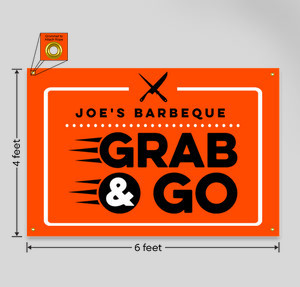
- Size range: Our vinyl banners go up to 6 ft × 4 ft and beyond. For large architectural wraps, contact our team to discuss custom sizing options.
- Best for: Grand openings, event backdrop displays, trade show booths, outdoor promotions, athletic field perimeter banners
For portable indoor display, our stand-up banners (retractable roll-up style, 30.5″ × 74″) use a tensioned roller mechanism inside an aluminum base. The banner rolls into the base for storage and transport, and sets up in under a minute. No hardware required.
Yard Signs & Lawn Signs

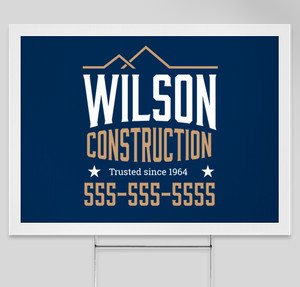
Yard signs are the workhorse of localized outdoor marketing. They are manufactured from twin-wall fluted polypropylene, a structural copolymer plastic with internal vertical channels (flutes) that provide rigidity without adding weight. The industry standard gauge for outdoor use is 4mm (approximately 0.157 inches thick, or 0.1875 lbs per square foot). A custom yard sign at this thickness holds up to normal wind, handles repeated stake insertions, and remains readable through a full campaign season.
Standard wire H-stakes insert directly into the vertical flutes of the sign. They are made from 9-gauge galvanized steel, which is lightweight, ships flat, and installs in seconds without tools. For longer campaigns or higher-wind environments, step stakes (welded 9-gauge top over a wider-base platform) provide better resistance to soil shifting and gusts above 25 mph. UV-cured inks printed direct-to-substrate bond to the polypropylene surface and resist moisture, oils, and normal road debris without lamination.
- Standard sizes: 18″ × 24″ is the default for real estate listings and local campaigns. 24″ × 36″ offers higher visibility for arterial roads. Larger formats are available for commercial development sites.
- Single- vs. double-sided: Single-sided is sufficient for roadside placements where traffic flows in one direction. Double-sided printing works when the sign faces two directions (driveway entrances, intersections).
- Best for: Political and school board campaigns, real estate open houses, local contractor visibility, graduation announcements, community event wayfinding, seasonal promotions
- Bulk pricing: Per-unit cost drops significantly in runs of 25 or more. If you’re running a multi-site campaign, ordering in bulk through our bulk order process saves money and ships everything together.
Car Door Magnets
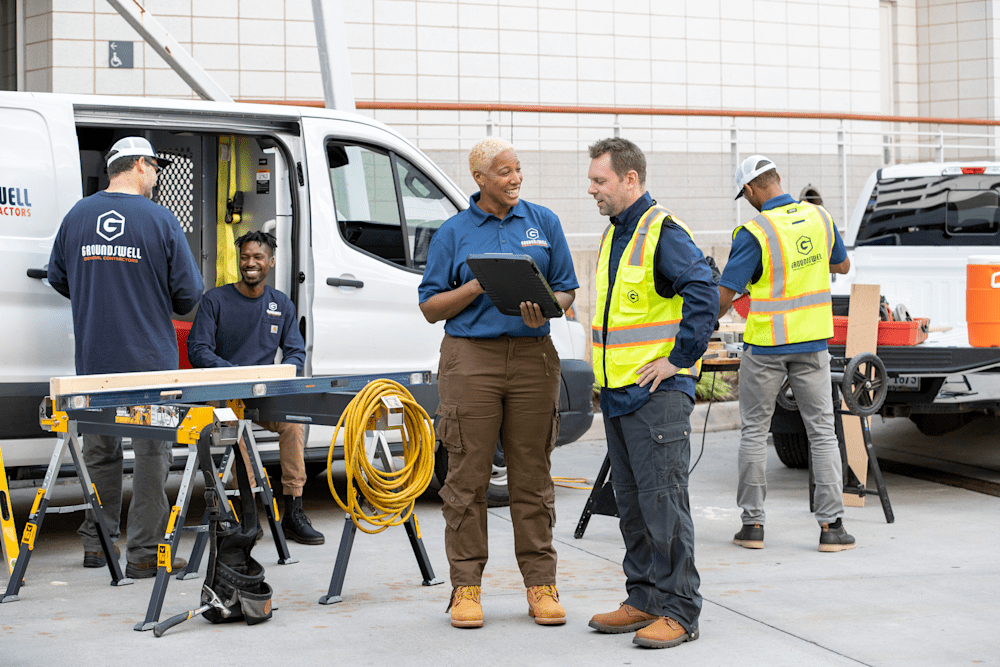
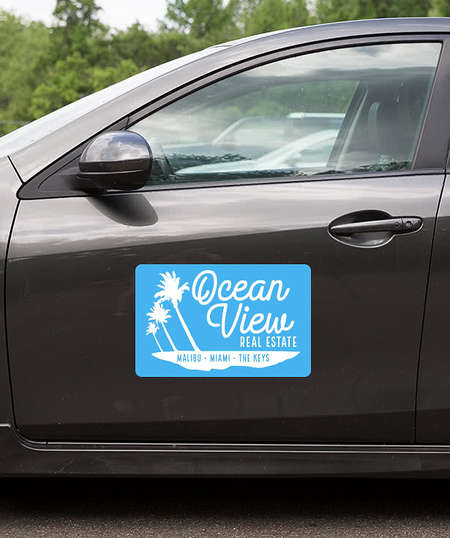
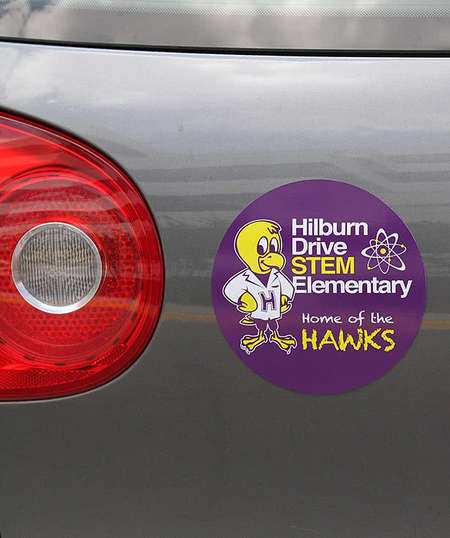
A service van sitting in a neighborhood while its technician works is essentially a free billboard for every passerby. Car door magnets turn that dead time into active brand exposure without permanently modifying the vehicle. Our custom car magnets use 30 mil high-energy magnetic sheeting (0.030 inches thick), which provides approximately 90 to 100 pounds of pull strength per square foot, which is enough to hold the sign securely at highway speeds without the stiffness that causes thicker magnets to bridge over curved door panels and detach.
A common issue with cheap imported car magnets is uneven backing surfaces or embedded contaminants that act like sandpaper against the door panel. Over time, this traps road grime underneath and can cause paint damage. Our magnets use a premium printed vinyl face over a flat, clean magnetic backing, combined with UV-resistant laminate to protect the print from fading and scratching.
- Surface compatibility: Car magnets adhere to ferrous metal only (steel and iron). They will not stick to aluminum panels, fiberglass doors, or plastic bumpers. Many modern pickup truck doors use aluminum. Check before ordering.
- Maintenance: Clean both the magnet backing and the door surface weekly with mild soap and water. This prevents road salt and grit from bonding to the surface or scratching the paint under the magnet.
- Storage tip: Store flat when not in use. Leaving a magnet rolled or curled causes “magnet memory.” The curl reduces surface contact and the sign can detach at highway speeds.
- Best for: Plumbers, electricians, handymen, HVAC technicians, mobile pet groomers, real estate agents, delivery services, and anyone who uses their personal vehicle for work calls
Our full color car door magnet is 18″ × 11.5″, sized for standard passenger doors and compact SUVs. For full van door panels or larger trucks, contact us about custom sizing options.
Feather Flags

Feather flags are vertical format, wind-responsive signs that generate movement and draw the eye from a distance. The flag material is lightweight polyester printed with dye-sublimation, which produces vibrant full-color graphics that don’t crack, peel, or fade the way screen-printed rigid signs can. Our 8-foot feather flags come with a ground stake for direct soil installation or a cross base for hard surfaces like concrete.
- Visibility advantage: The tall vertical format makes feather flags visible from distances and angles where traditional horizontal banners get lost in visual clutter. They work well flanking a storefront entrance or lining the perimeter of an outdoor event.
- Portability: The aluminum pole collapses and the flag packs flat. A single person can carry several flags and set them up in minutes. This is a strong advantage for events that move from location to location.
- Best for: Grand openings, outdoor pop-up events, car dealership lots, farmers markets, school spirit displays, athletic event sidelines, storefront curb appeal
- No minimum: Feather flags are available with no minimum order quantity, so you can order one for a single event or a dozen for a larger activation.
How to Design a Sign That Gets Noticed
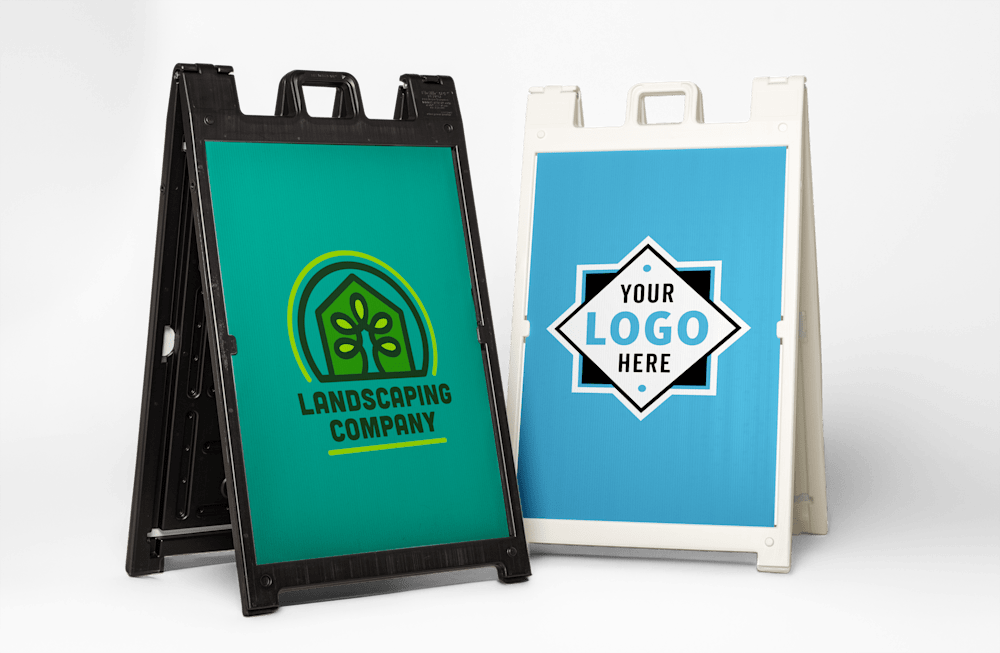
Material quality and placement only get you so far. A well-made sign with a hard-to-read design still fails. The good news: our Design Lab is built around this problem, with templates sized and structured for each sign type. Here are the core design rules that apply regardless of format.
Sign Legibility: The 1-Inch-to-10-Feet Rule
The United States Sign Council (USSC) established the baseline: every 1 inch of capital letter height provides approximately 10 feet of maximum readability. For a yard sign viewed from a car traveling at 35 mph, minimum readable letter height is 9 inches. On a banner at a trade show viewed from 10 feet away, 1-inch letters are sufficient. When in doubt, go bigger. Letters are almost never too large.
| Viewing Context | Approximate Distance | Minimum Letter Height | Recommended for Maximum Impact |
|---|---|---|---|
| Trade show booth / lobby | Up to 10 ft | 1 inch | 2–4 inches |
| Pedestrian sidewalk / event entrance | Under 200 ft | 3–5 inches | 6–12 inches |
| Local road (35 mph) | ~280 ft | 9 inches | 18–24 inches |
| Arterial road (45 mph) | ~360 ft | 12 inches | 24–36 inches |
| Highway (>55 mph) | ~445 ft | 15–17 inches | 36–48 inches |
Keep Copy Short
Signs viewed by moving people (whether driving or walking) get two to three seconds of attention. The American Sign Council recommends a maximum of six words or 30 total characters for roadside signs. If your message needs more than that to be clear, it is not ready to be on a sign yet.
Lead with the most important elements: your business name, the event name, or the single action you want someone to take.
Contrast Is Non-Negotiable
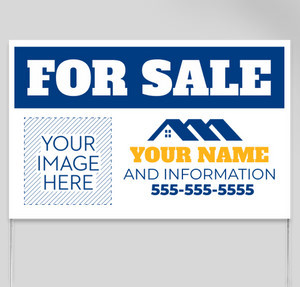
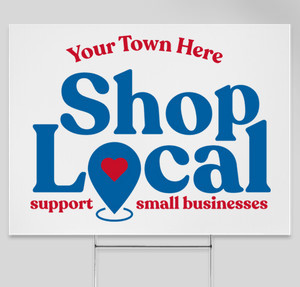
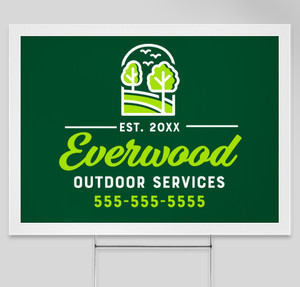
The ADA and International Code Council recommend a minimum contrast ratio of 70% (measured by the difference in Light Reflectance Value between background and text). In practice: dark text on a light background or white text on a dark background. White on navy, black on yellow, and dark green on white all perform well. White text on gray or light tan does not meet the threshold and will be nearly unreadable in direct sunlight. Avoid script, italic, or decorative fonts. Sans-serif typefaces like Arial, Helvetica, or Verdana read clearly at distance and at an angle.
How to Order Custom Signs
Ordering from us takes four steps, and our team is available every day if you have questions along the way.
- Choose your sign type. Start at our custom signs and banners hub and select the format that matches your use case. The comparison table above and the product filter options on each category page narrow it down quickly.
- Design your sign. Open the Design Lab to start from scratch, upload your existing artwork, or customize one of our templates. Every template is sized correctly for the product, so you are never guessing about margins or bleed areas. If your logo file needs cleanup, our design experts review every order at no extra charge.
- Review your proof. Before production begins, you will receive a digital proof showing exactly how your sign will look. No surprises at delivery.
- Choose your delivery timeline. Standard orders ship with free standard shipping and arrive within two weeks. If your event is closer than that, rush production and shipping options are available.
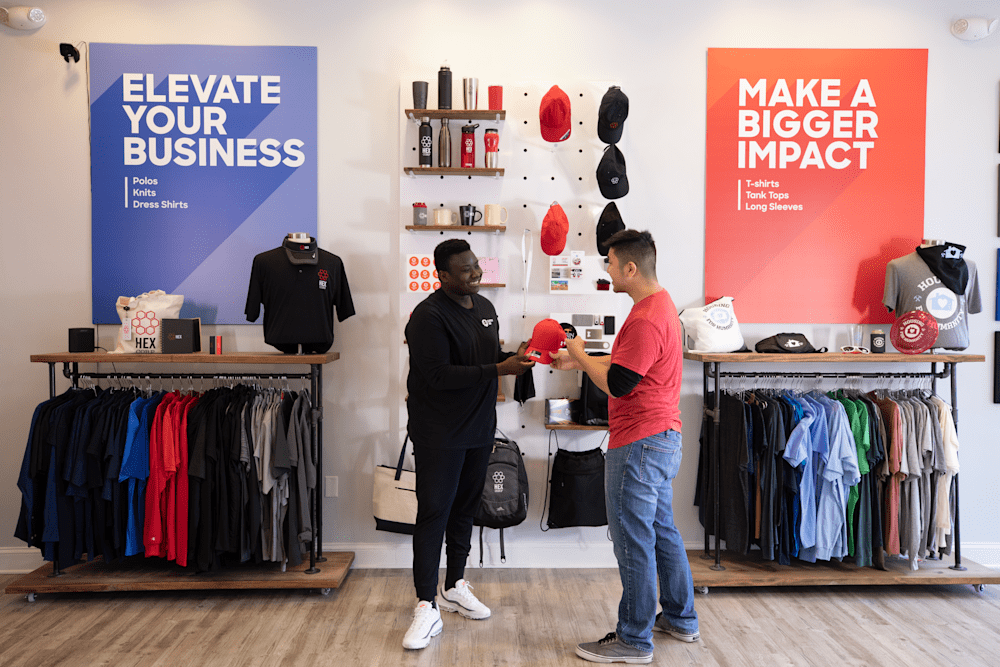
Our team is reachable by phone, chat, or email seven days a week. If you are coordinating apparel and signage for the same event, we can manage both in a single order, which simplifies logistics and ensures everything arrives together.
Frequently Asked Questions
Q: How long does it take to get custom signs?
Standard custom sign orders arrive within two weeks with our free standard shipping. If your event is less than two weeks out, we offer rush production and expedited shipping options. Contact us to discuss what is feasible for your timeline.
Q: Can I order just one custom sign?
Many of our sign products, including feather flags and stand-up banners, are available with no minimum order quantity. Yard signs typically have a minimum of two. Check the individual product page for quantity requirements, or contact us and we will point you to the right option.
Q: What is the best custom sign for outdoor use?
It depends on the duration and environment. For temporary outdoor use of six to twelve months, 4mm corrugated polypropylene yard signs or 13 oz scrim vinyl banners are the standard. Both use UV-cured inks that resist moisture and fading through a full season. For permanent or semi-permanent exterior branding that needs to last multiple years, contact us about rigid aluminum sign options, which are rust-proof and hold up in sustained weather.
Q: Can I get help designing my custom sign?
Yes. Our design experts are available to help you refine your layout, clean up artwork files, or scale a logo for large-format printing at no extra charge. You can also start in the Design Lab using any of our templates, which are pre-sized and pre-configured for each product type.
Q: Are bulk discounts available for custom signs?
Yes. Per-unit pricing decreases as quantity increases across most sign products. Yard signs in runs of 25 or more show significant per-piece savings. Use the quantity input on the product page to see current pricing tiers, or contact us for a quote on larger runs.
Q: Can I order custom signs and branded apparel in the same order?
Yes. We handle both. We have customers who coordinate event banners, yard signs, and branded apparel in a single order for launches, campaigns, and charity events. Managing it together simplifies proofing and ensures consistent colors and branding across every item. Start at our custom signs hub and use the cart to add apparel items alongside your signage order.

The Custom Ink Staff is a team of design enthusiasts and promo product experts dedicated to bringing your ideas to life. From screen printing secrets to the latest trends in custom gear, we draw on decades of collective experience to help you create something unforgettable.