Custom Yard Signs and Lawn Signs: The Complete Buyer’s Guide
 Posted By Custom Ink Staff —
The Custom Ink Staff is a team of design enthusiasts and promo product experts dedicated to bringing your ideas to life. From screen printing secrets to the latest trends in custom gear, we draw on decades of collective experience to help you create something unforgettable.
SHARE:


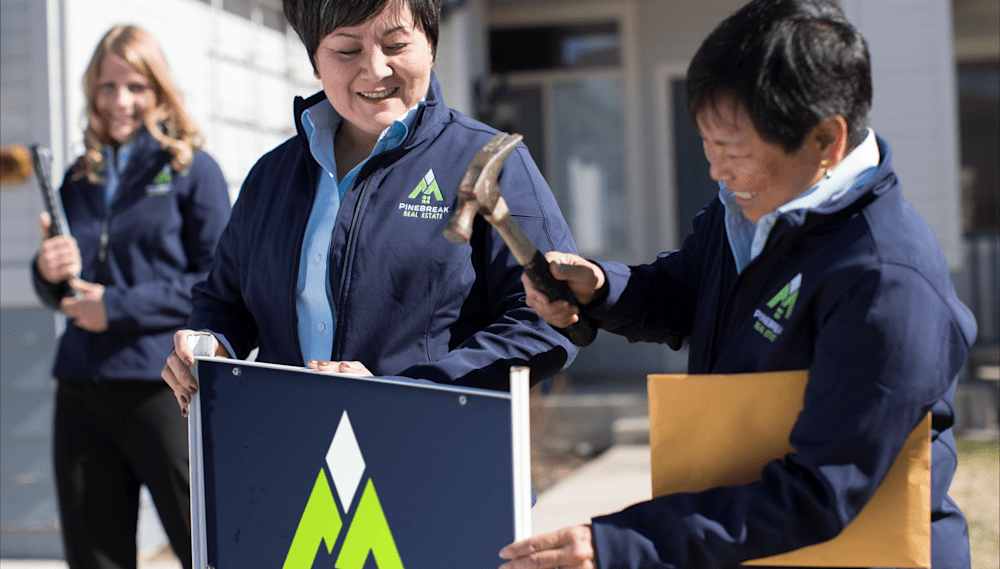
The plastic yard sign does a lot of heavy lifting. It announces a graduation in the front yard. It points wedding guests from a highway exit to a barn venue. It tells a neighborhood that a house is for sale, a campaign is running, a contractor is working nearby, or a grand opening is this weekend. No other format covers that range of use cases at that price point.
A FedEx Office “Signs of the Times” survey found that 76% of consumers have walked into a business they had never visited before based solely on its signs, and a well-placed lawn sign works the same way, whether your goal is foot traffic, votes, or just making sure Grandpa finds the party.
The decisions that separate a sign that works from one that falls over, fades early, or never gets read are almost always material, size, and design choices. This guide covers all three so your custom yard signs hold up through whatever you are using them for.
In This Article
- Material Guide: Which Corrugated Plastic Is Right?
- Size Selection: Match Your Sign to Your Viewing Distance
- Stake Types: H-Wire, Step, and Spiral Compared
- Use Cases: Which Setup for Your Situation
- Design Rules That Work Outdoors
- Ordering in Bulk
- How to Order
- Frequently Asked Questions
Key Takeaways
- 4mm corrugated polypropylene is the industry standard: At 0.1875 lbs per square foot and roughly 0.157 inches thick, it handles a full outdoor season (6 to 12 months) and works with standard 9-gauge steel H-wire stakes that insert directly into the flutes.
- 18″ x 24″ is the default for a reason, viewed from a moving car at 25 to 35 mph, letter heights of 3 to 5 inches are readable. That fits comfortably on an 18″ x 24″ layout with room for a logo, phone number, and one strong headline.
- 44% of buyers put quality first on non-apparel branded items, per our 2026 Swag Trends Survey, “Longevity/Quality” is the top purchasing factor. Saving $0.50 per sign by going to 3mm corrugated plastic instead of 4mm costs you more when signs buckle after one windstorm mid-campaign.
Sign Material Guide: Which Corrugated Plastic Is Right?
Most custom yard signs are made from corrugated polypropylene, a twin-wall plastic with vertical internal channels (flutes) that provide structural rigidity. The gauge, or thickness of the material, matters more than most buyers realize. It makes all the difference between a sign that looks good on day one versus a sign that still looks good in six weeks.
| Material | Thickness | Weight (per sq ft) | Outdoor Lifespan | Best For | Wind Resistance |
|---|---|---|---|---|---|
| 3mm corrugated polypropylene | 0.118 inches | ~0.12 lbs | 3–4 months | Short-run events, garage sales, indoor wayfinding | Low (<20 mph sustained) |
| 4mm corrugated polypropylene | 0.157 inches | 0.1875 lbs | 6–12 months | Campaigns, real estate, contractors, seasonal business | Medium (20–30 mph sustained) |
| 6mm corrugated polypropylene | 0.236 inches | ~0.30 lbs | 12–18+ months | High-wind zones, multi-season commercial use, roadside arterials | High (30+ mph sustained) |
| Aluminum (.040 gauge) | 0.040 inches | ~0.56 lbs | 5+ years | Permanent ADA signs, parking lot markers, regulatory signage | Very high (when mounted) |
For real estate listings, political campaigns, and contractor advertising, 4mm is the right choice. It is heavy enough to stay rigid in normal weather, light enough to carry 25 to 50 signs in one trip, and sized to accept standard 9-gauge H-wire stakes without modification.
UV-cured inks bond directly to the polypropylene surface and resist moisture, road debris, and normal oil or solvent contact without a laminate layer. It ensures a sign looks sharp even after being outdoors for six weeks.
Size Selection: Match Your Sign to Your Viewing Distance
The United States Sign Council established this visibility rule: Every 1 inch of capital letter height delivers approximately 10 feet of readable distance. Before choosing a custom sign size, identify the furthest point from which your target viewer will be reading it, and the speed at which they are traveling. A sign near a 45 mph arterial road needs very different dimensions than one at the entry of a subdivision where cars are moving at 15 mph.
| Sign Size | Ideal Viewing Context | Min. Letter Height for Readability | Common Use Cases |
|---|---|---|---|
| 12″ x 18″ | Pedestrian traffic, slow residential streets | 1.5–2 inches | Open house directional arrows, wedding wayfinding, graduation yard displays |
| 18″ x 24″ (standard) | Residential streets, local roads (25–35 mph) | 3–5 inches | Real estate listings, campaign signs, contractor advertising, small business promotions |
| 24″ x 36″ | Arterial roads (35–45 mph) | 5–7 inches | High-visibility contractor branding, multi-candidate campaign signage, commercial real estate |
| 36″ x 48″ + | Highway frontage, commercial development sites | 8–12 inches | Industrial development, large commercial project announcements, highway-visible business signage |
The 18″ x 24″ yard sign became the industry default because it fits a five-word headline with 4 to 5 inch letters, a phone number or URL at 2 inches, and a logo mark with room to breathe. It loads efficiently into standard wire stakes, stacks flat in most car trunks, and sits low enough to not require municipal permits in most jurisdictions. If your viewing context is an arterial road rather than a residential street, jump to 24″ x 36″ rather than trying to cram smaller text onto the standard size.
Stake Types: H-Wire, Step, and Spiral Compared
Your stake choice determines installation speed, soil compatibility, and wind resistance. Most buyers overlook this decision entirely, then wind up with signs leaning or falling after the first rain. Here is what each type actually does.
| Stake Type | Construction | Best Soil | Installation | Wind Resistance | Best For |
|---|---|---|---|---|---|
| 9-gauge H-wire stake | Lightweight galvanized steel, H-shaped, inserts into flutes | Loose to medium soil | Push by hand | Low–Medium | Short campaigns, residential grass, high-volume installs |
| Step stake (welded base) | 9-gauge top wire welded to wider flat-base bottom | Medium to hard-packed soil | Step to drive in | Medium–High | Longer campaigns, high-traffic roadsides, commercial property edges |
| Spiral stake | Corkscrewed steel rod, screws into soil | Hard soil, clay, construction sites | Twist to install; tool may help | High | Construction signage, long-term contractor advertising, windy rural sites |
| Rigid angle-iron frame | Welded metal frame, sign slides in | N/A (permanent ground mount or sleeve) | Requires post hole or sleeve | Very high | Semi-permanent real estate frames, office park directories, colonial post systems |
For a campaign covering 50 to 100 residential locations, signs with 9-gauge H-wire stakes are the right call: fast, light, and cheap to replace if they bend. For a contractor advertising a job site on a busy road for several weeks, the step stake is worth the extra cost. It provides a wider base footprint that resists the rocking motion caused by wind and passing trucks. For any installation that needs to survive more than 60 days on a commercial property, consider spiral stakes or a permanent frame.
Yard Sign Use Cases: Which Setup Suits Your Situation

Different buyers need very different configurations. Here is a quick decision guide for the most common custom yard sign use cases.
Real Estate Agents
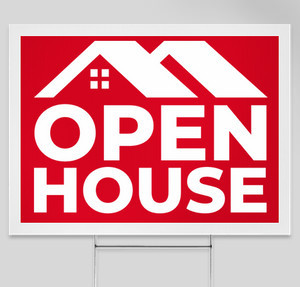
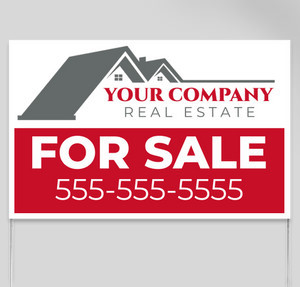
Real estate yard signs are the category’s single largest use case. For active listings, 18″ x 24″ double-sided at 4mm is the standard. Double-sided printing matters for properties at intersections or on corner lots where traffic approaches from two directions. Keep the design to four elements: brokerage logo, agent name, phone number, and a “For Sale” or “Open House” header. Directional arrow signs (12″ x 18″) in the same design style help buyers navigate from a major road to a cul-de-sac property. For open house, go with a set of five coordinated signs: the main listing sign, plus four directional arrows.
- Recommended size: 18″ x 24″ (listing) + 12″ x 18″ (directional arrows)
- Material: 4mm corrugated polypropylene, double-sided
- Stake: H-wire for temporary listings; step stake for active listings running longer than 30 days
- Design rule: Agent name at minimum 2 inches; phone number at minimum 1.5 inches; no more than five total design elements
Political and Community Campaigns
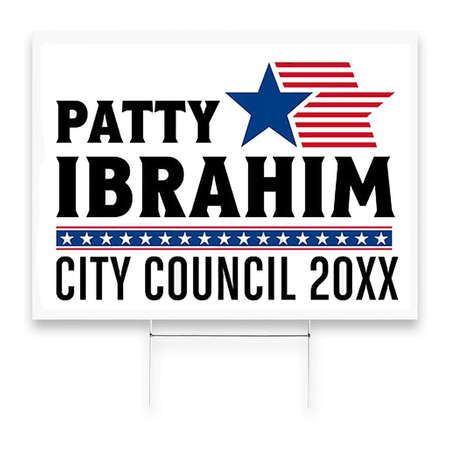
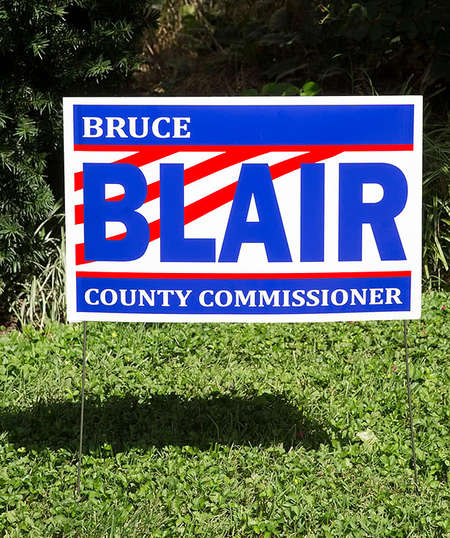
Political campaigns live or die by name recognition, and yard signs are among the most cost-efficient tools available for building your community presence. Research cited by the University of Wisconsin-Madison found that political yard signs in high-visibility placements can increase a candidate’s vote share by 1.7 percentage points, which can decide tight local races. A sign placed in one yard is seen by every neighbor, delivery driver, and passerby who travels that street over the life of the campaign. For local elections, 18″ x 24″ single-sided at 4mm signs in the campaign’s primary color is the standard setup. Bulk orders of 100+ bring per-unit costs down significantly.
- Recommended size: 18″ x 24″ for residential neighborhoods; 24″ x 36″ for arterial roads and commercial strips
- Material: 4mm corrugated polypropylene, single-sided (unless placement is on a corner)
- Stake: H-wire for residential placements; step stake for roadsides and high-traffic intersections
- Bulk strategy: Order in batches. A first run of 50 for supporter placement, then a second run of 100 to 200 for the final two weeks. Our bulk pricing tiers reduce per-unit cost significantly at higher quantities.
Contractors and Service Businesses
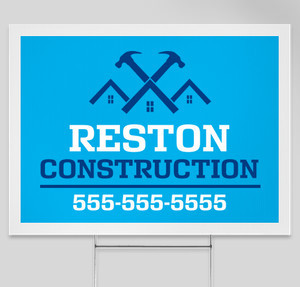
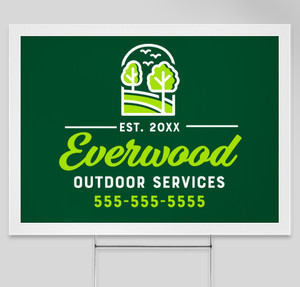
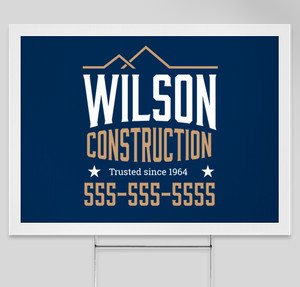
Every job site is a marketing opportunity. A roofing crew working on a residential street has the attention of every neighbor driving by for two to five days, and a well-placed sign turns that window into leads at essentially zero incremental cost. Include your business name, one service description, phone number, and optionally a QR code to your booking page. For commercial strip work or arterial road placements, move to 24″ x 36″.
- Recommended size: 18″ x 24″ for residential; 24″ x 36″ for commercial property and arterial roads
- Material: 4mm for seasonal jobs; 6mm for long-running construction sites (6+ weeks)
- Stake: Step stake for construction sites where vehicles and equipment operate nearby
- QR code tip: A QR code in the lower corner links passersby directly to your website without requiring them to type a URL. Keep the QR code at minimum 1.5″ x 1.5″ so it scans correctly at arm’s length.

Events and Celebrations
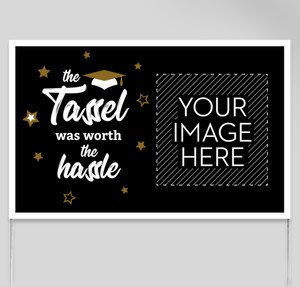
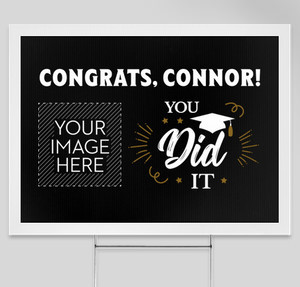
For graduations, birthday parties, and weddings, yard signs handle both decoration and guest wayfinding. Oversized 24″ x 36″ graduation signs with the graduate’s name have become a front-yard tradition. For event wayfinding, a set of 12″ x 18″ directional arrow signs in a consistent design guides guests from a main road to a venue entrance. Since these are typically one-time-use, 4mm single-sided is the right call.
Design Rules That Work Outdoors
Our Design Lab has templates sized and optimized for each yard sign format, but whether you start from a template or upload your own artwork, these rules apply.
- Six words maximum. Signs viewed from a moving car get two to three seconds of attention. Six words or 30 total characters is the maximum that reads cleanly in that window. If your message cannot fit that constraint, divide it across two signs (headline + directional).
- 70% contrast minimum. The ADA and International Code Council specify a minimum Light Reflectance Value (LRV) contrast of 70% between text and background. High-contrast combinations that work: white on navy, black on white, black on yellow, white on red, dark green on white. Low-contrast combinations that fail: white on gray, light blue on white, yellow on white.
- Sans-serif fonts only. Script, italic, and decorative typefaces lose legibility at angle and distance. Helvetica, Arial, Franklin Gothic, and similar fonts read well at 30 feet. Your brand font may not.
- Minimum 150 DPI at print size. For a 4″ headline on an 18″ x 24″ sign, your art file needs to be at least 150 DPI at full print dimensions. Vector formats (PDF, EPS, SVG) are preferable. If you are uploading a JPEG, confirm it is at least 2700 x 3600 pixels for standard 18″ x 24″ production.
- Keep critical content 0.5″ inside the edge. Allow a safe zone of at least 0.5 inches from the trim edge on all sides. This ensures important text and logos are not lost to edge variation during production. For double-sided signs, check that bleed areas extend to the die-cut line.
Ordering Yard Signs in Bulk: When and How
Yard signs have strong bulk pricing tiers because production setup costs are fixed regardless of quantity. Printing 10 signs and printing 100 signs uses the same file setup, the same ink run, and essentially the same production time. The per-unit cost drops substantially as quantity climbs, which makes bulk the obvious choice for any campaign, real estate team, or contractor fleet with multiple concurrent placements.
A practical way to order for a local campaign or ongoing real estate business: use a consistent base design for your primary sign quantity, then order a small run of specialty signs, including open house dates, directional arrows, or event-specific messages, separately. Our delivery options include rush turnaround, so if a job site opportunity or event comes up with two weeks’ notice, you are not locked out. Free standard shipping applies to all orders, with delivery in approximately two weeks.
How to Order Custom Yard Signs
- Choose your size and material. Start at our custom signs page. Select based on your primary viewing distance using the size table above. Standard 18″ x 24″ at 4mm covers most use cases.
- Design your sign. Open the Design Lab to start with one of our yard sign templates or upload your existing artwork. Templates are pre-sized with correct bleed areas already set. Our design team reviews every file before production.
- Select single- or double-sided printing. If your sign will be visible from both directions (corner lot, intersection, median), double-sided is worth the added cost. Single-sided is sufficient for one-direction roadside placements.
- Add stakes. Choose H-wire for standard residential installation or step stakes for roadside and commercial property. If you already have frames, you can order sign blanks without hardware.
- Review your proof and submit. You will receive a digital proof before production begins. Free standard shipping delivers within approximately two weeks. Rush options are available if your timeline is tighter.
For a larger-scale need, like an entire custom signs package that includes yard signs, banners, and event flags, we can coordinate everything in one order so all your signage arrives together in consistent brand colors before your campaign or event date.
Frequently Asked Questions
Q: What is the standard size for custom yard signs?
The standard size for custom yard signs and lawn signs is 18″ x 24″, made from 4mm corrugated polypropylene. This size fits a legible headline at 4 to 5 inch letters, a phone number or URL, and a logo with comfortable margins. It is the default for real estate listings, political campaigns, and contractor advertising because it is readable from a car at 25 to 35 mph and fits easily on H-wire stakes.
Q: How long do custom yard signs last outdoors?
At 4mm corrugated polypropylene with UV-cured inks, custom yard signs hold up for 6 to 12 months outdoors under normal weather conditions. UV-cured inks bond directly to the polypropylene surface and resist moisture, fading, and abrasion without a protective laminate. In coastal climates or high-UV environments, expect the shorter end of that range. For multi-season use, 6mm corrugated plastic extends the lifespan to 12 to 18 months or more.
Q: Can I order custom yard signs in bulk?
Yes. Per-unit pricing decreases as quantities increase. For campaigns, real estate teams, and contractor fleets ordering 25 or more signs, the per-piece savings are significant. Use the quantity selector on our product page to see real-time pricing, or contact us for a bulk quote on larger runs. Free standard shipping applies to all orders.
Q: What file format should I use for my yard sign artwork?
Vector formats (PDF, EPS, SVG) are preferred for yard signs because they scale without loss of quality at any print size. If you are uploading a raster image (JPEG, PNG, TIFF), your file should be at least 150 DPI at the final print dimensions of your sign. For a standard 18″ x 24″ sign, that means a minimum resolution of 2700 x 3600 pixels. Our design team reviews every file before production and will flag resolution issues before your order goes to print.
Q: Do custom yard signs come with stakes?
Stakes are available as an add-on when you order. Standard 9-gauge H-wire stakes insert directly into the vertical flutes of the corrugated polypropylene and require no tools. Step stakes, which have a welded wide-base bottom for firmer installation in harder soil, are also available. If you already have frames or stakes from a previous order, you can order sign blanks only.
Q: How long does it take to get custom yard signs?
Standard orders arrive within approximately two weeks with our free standard shipping. Rush production and expedited shipping options are available if your event or campaign launch is sooner. Contact us to discuss what is feasible for your timeline.

The Custom Ink Staff is a team of design enthusiasts and promo product experts dedicated to bringing your ideas to life. From screen printing secrets to the latest trends in custom gear, we draw on decades of collective experience to help you create something unforgettable.