The State of the Employee Welcome Kit: What HR Teams Are Struggling With — and What Employees Actually Want
 Posted By Custom Ink Staff —
The Custom Ink Staff is a team of design enthusiasts and promo product experts dedicated to bringing your ideas to life. From screen printing secrets to the latest trends in custom gear, we draw on decades of collective experience to help you create something unforgettable.
SHARE:


Most HR teams assume the biggest barrier to a great Welcome Kit is budget. Our new research says otherwise — and it also reveals exactly what employees wish their kits actually contained.
We ran two parallel surveys as part of our 2026 Employee Onboarding Experience Audit: one with 300+ HR professionals responsible for building Welcome Kits, and one with 300+ employees who’ve received — or didn’t receive — one on their first day. Together, they tell a story about a gap that’s almost entirely closeable, if you know where to look.
In This Article
- Three-Quarters of HR Professionals Aren’t Sure It’s Working
- The Real Barrier Isn’t Budget. It’s Curation.
- So We Asked Employees What They Actually Want
- The Timing Problem: Late Is Almost as Bad as Nothing
- Quality Sends a Message — and So Does Cheap Gear
- The Business Case: Half of Employees Say Onboarding Affected Their Tenure
- What This Means If You’re Building a Kit Right Now
- Frequently Asked Questions
Key Takeaways
- 74% of HR professionals lack full confidence that their Welcome Kit is making a real impression — and the #1 reason isn’t budget, it’s not knowing what to put in the box.
- A high-quality water bottle or tumbler is the #1 employee wish list item at 43%, seven points ahead of the next choice. Employees aren’t asking for more items — they’re asking for better ones.
- Timing matters as much as contents — employees who received a kit on Day 1 were nearly twice as likely to feel they completely belonged from the start. Late delivery performed almost identically to no kit at all.
- 50% of employees say onboarding quality directly affected how long they stayed — making Welcome Kit investment an argument you can take to finance.
Three-Quarters of HR Professionals Aren’t Sure Their Kits Are Working
Only 26% of HR professionals say they’re “extremely confident” their onboarding kits make new hires feel welcomed and valued.
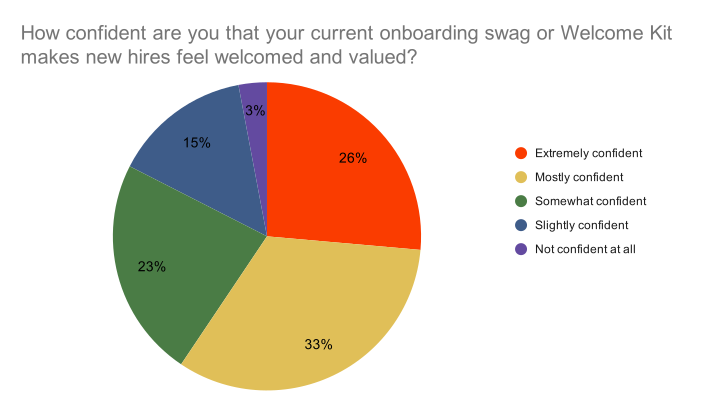
The other 74% fall somewhere between “mostly confident” and “not confident at all.” They’re ordering the kits. They’re shipping the boxes. They just aren’t sure it’s landing.
| How confident are you your Welcome Kit makes new hires feel welcomed and valued? | % of Respondents |
|---|---|
| Extremely confident | 26% |
| Mostly confident | 33% |
| Somewhat confident | 23% |
| Slightly confident | 15% |
| Not confident at all | 3% |
There’s a direct path out of this uncertainty. And it starts with understanding why so many organizers feel it in the first place.
The Real Barrier Isn’t Budget. It’s Curation.
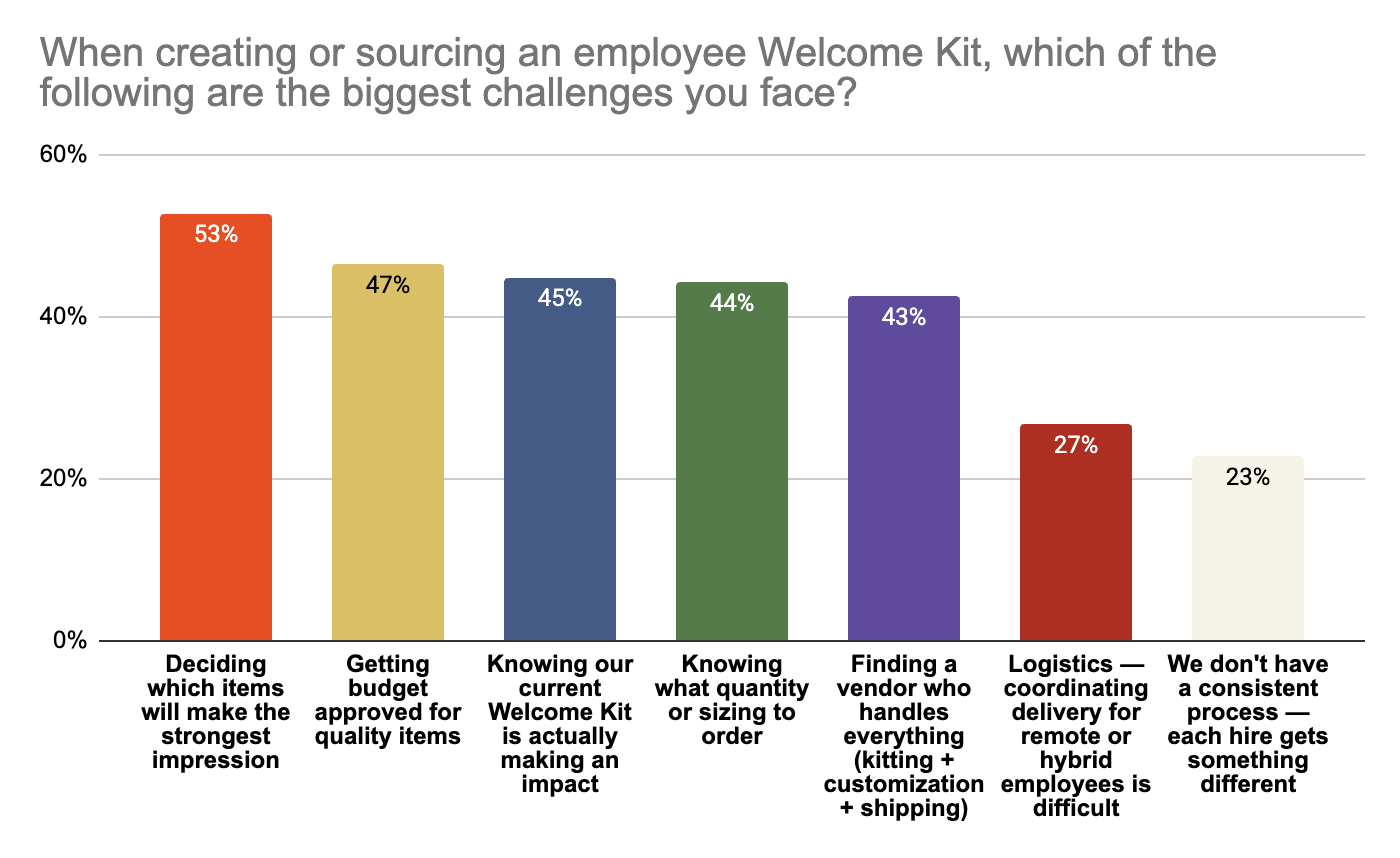
When we asked HR professionals to identify their biggest challenges, “deciding which items will make the strongest impression” came in first at 53% — beating budget approval by six points, and outranking every logistical and operational challenge on the list.
| What are your biggest challenges when creating a Welcome Kit? (select all that apply) | % of Respondents |
|---|---|
| Deciding which items will make the strongest impression | 53% |
| Getting budget approved for quality items | 47% |
| Knowing if the current kit is actually making an impact | 45% |
| Knowing what quantity or sizing to order | 44% |
| Finding a vendor who handles everything (kitting + shipping) | 43% |
| Logistics — remote or hybrid delivery coordination | 27% |
| No consistent process — each hire gets something different | 23% |
Curation is the #1 challenge. Not cost. That reframing matters, because curation is a solvable problem — especially when you have direct input from the people opening the boxes.
For a deeper look at how spend levels, measurement habits, and remote delivery logistics break down for organizers, see our full report: The Welcome Kit Confidence Gap: What HR Professionals Really Think About Onboarding Swag.
So We Asked Employees What They Actually Want
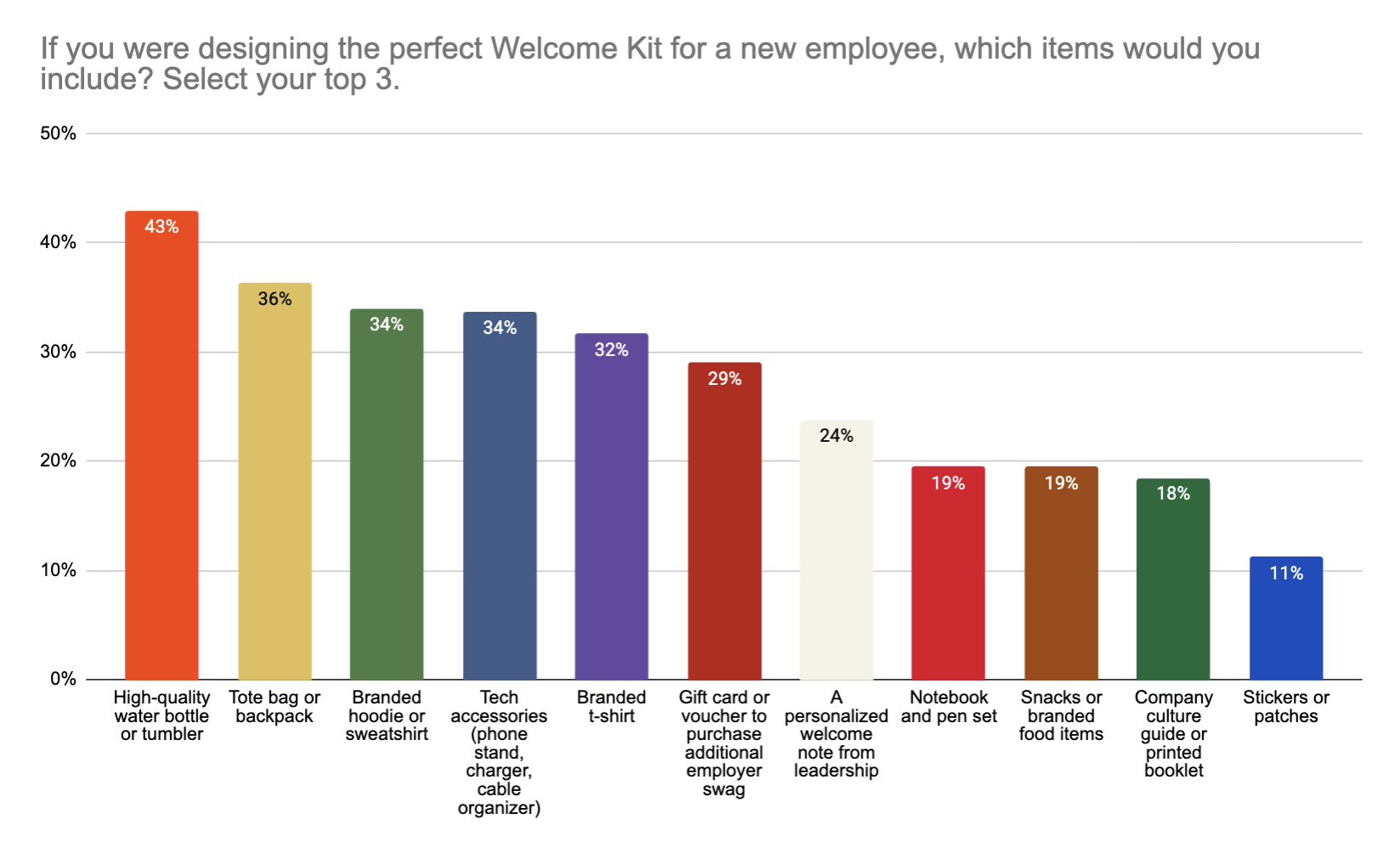
The second half of our audit surveyed 303 employees — people who’ve actually started new jobs, gone through onboarding, and opened (or didn’t open) a Welcome Kit — about what they’d put in a perfect kit if they were building it themselves.
The answer to the curation problem turns out to be fairly clear.
| If you were designing the perfect Welcome Kit, which items would you include? (Select top 3) | % of Respondents |
|---|---|
| High-quality water bottle or tumbler | 43% |
| Tote bag or backpack | 36% |
| Branded hoodie or sweatshirt | 34% |
| Tech accessories (phone stand, charger, cable organizer) | 34% |
| Branded t-shirt | 32% |
| Gift card or voucher to choose their own swag | 29% |
| A personalized welcome note from leadership | 24% |
| Notebook and pen set | 19% |
| Snacks or branded food items | 19% |
A few things worth noting in that list.
The water bottle or tumbler won by a significant margin. A quality tumbler is used every single day, sits on the desk, and signals genuine investment. It’s a brand impression that compounds over time. The key word in the wish list description is high-quality. A cheap bottle wouldn’t place anywhere near the top, as we saw in our 2026 Swag Trends Report.
The hoodie edges out the t-shirt. 34% want a branded hoodie; 32% want a t-shirt. The gap is small, but the signal is clear: employees want apparel they’d actually choose to wear. A quality hoodie costs more than a standard tee — and that’s the point. The extra spend communicates something that a $6 t-shirt quietly undermines.
The personalized welcome note punches above its price. At 24%, it’s the only non-physical item in the top half of the list, ranking above snacks, notebooks, and culture guides. Something personally signed from a manager or executive carries weight that no branded item alone can replicate.
For a full breakdown of employee attitudes — including how belonging scores differ by kit experience, what employees remember most about their onboarding, and how the quality bar has risen over time — see: We Asked 303 Employees What They Actually Want in a Welcome Kit.
The Timing Problem: Late Is Almost as Bad as Nothing
Knowing what to include is half the equation. When the kit arrives is the other half — and the data here is more stark than most employers probably expect.
| Feeling on Day 1 | Kit on Day 1 | Kit Arrived Late | No Kit |
|---|---|---|---|
| Completely belonged from Day 1 | 34% | 15% | 18% |
| Mostly welcomed, but gaps | 37% | 27% | 26% |
| Took time to feel included | 22% | 49% | 44% |
| Felt like a stranger for weeks | 7% | 9% | 12% |
Employees who received a kit on Day 1 were nearly twice as likely to say they completely belonged from the moment they arrived — 34% vs. 18% with no kit at all. That’s meaningful. But the finding that deserves equal attention: a late kit is nearly as damaging as no kit. Late recipients look almost identical to the no-kit group across every belonging measure. 49% of late recipients said it took time to feel included — compared to 44% with no kit. The numbers essentially tie.
This is especially important for remote and hybrid teams, where the kit is often the only tangible first-day experience a new hire receives. On the organizer side of our survey, only 50% of remote-enabled organizations successfully ship the kit before the start date. The other half are missing the window that drives the result.
It’s a gap our own team has even felt firsthand.
“Having something waiting for you when you open your laptop on Day 1 — something that connects you to something bigger — just feels good. It won’t replace walking the halls of a new office, but it closes some of that gap.”
Aubrey Cirillo, Director of Talent Acquisition, Custom Ink
Our delivery options are built to get kits to employees — remote or in-office — before Day 1. We can ship directly to their home so the box is waiting when they open their laptop for the first time.
Quality Sends a Message — and So Does Cheap Gear
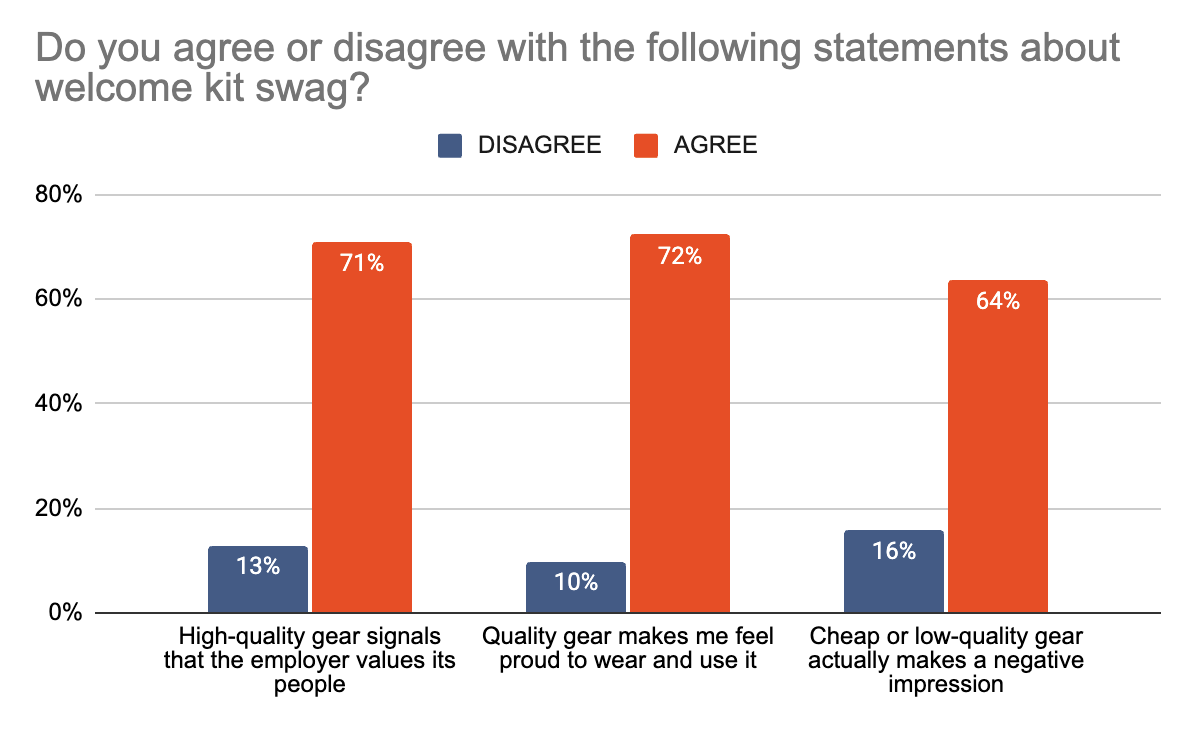
The employee data on gear quality is direct. 72% agree that high-quality gear makes them feel proud to wear and use it. 71% say it signals the employer values its people. Neither of those numbers is surprising.
This one is: 64% of employees say cheap or low-quality branded gear creates a negative impression of the employer. A low-quality kit isn’t neutral. It sends a message — just not the one you intended. The employers who understand this spend more per hire, choose fewer but better items, and report significantly higher confidence that their kit is working.
If you’re choosing between upgrading the quality of one item or adding another cheap one to the box, the data says upgrade.
The Business Case: Half of Employees Say Onboarding Affected Their Tenure
50% of employees say the quality of their overall onboarding experience directly affected how long they stayed at a job. 33% said a strong onboarding made them more committed to staying. 17% said a poor one made them leave, or want to leave, sooner. Adding in partial influence, total onboarding impact on tenure reaches 69%.
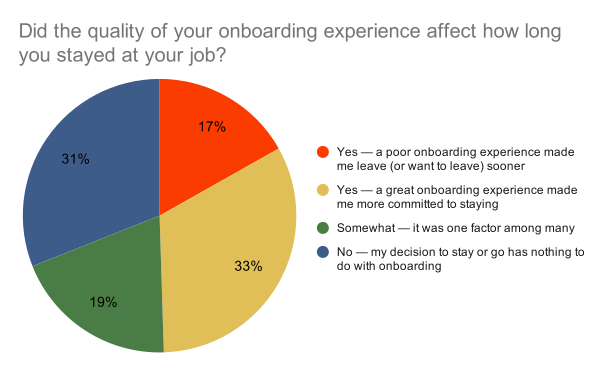
The average cost to replace an employee runs between 1.5 and 2 times their annual salary. When a third of your workforce says a strong onboarding made them more committed to staying, the math on a $75 Welcome Kit looks very different than it did as a line item in the HR budget.
This isn’t an argument for lavish onboarding budgets. It’s an argument for intentional ones. The kit that’s carefully chosen, well-made, and delivered before Day 1 is doing retention work that shows up much later in headcount spreadsheets.
What This Means If You’re Building a Kit Right Now
Taken together, the two sides of this survey point to a fairly clear brief:
- Lead with a quality tumbler or water bottle. It’s the #1 wish list item by a wide margin, used daily, and carries the brand impression longer than almost anything else in the kit.
- Choose a hoodie over a basic tee if you can. Employees want apparel they’ll actually reach for. The quality signal matters.
- Add a bag — tote or backpack. Functional items that employees use outside the office extend brand reach in a way that desk accessories don’t.
- Include a handwritten note. It costs nothing to add and ranks in the top half of the employee wish list. Someone in leadership taking 30 seconds to sign something personal lands differently than anything you can order.
- Ship before Day 1. A kit that arrives on week two isn’t an onboarding moment. It’s a late shipment. Build your lead time accordingly.
- Measure something. Organizers who formally track onboarding impact are ten times more likely to feel extremely confident in their kit than those who want to measure but haven’t started. Even anecdotal feedback — a Slack message, a photo of someone wearing the hoodie — is better than guessing.
We help teams build employee Welcome Kits from design through delivery — including direct-to-employee shipping, no minimums on many styles, and our design experts who can help you build a kit that actually lands. If you’re not sure where to start, our Inkers can help you figure it out.
Want to go deeper? Read the full organizer findings in The Welcome Kit Confidence Gap, or see the complete employee data in We Asked 300+ Employees What They Actually Want in a Welcome Kit.

The Custom Ink Staff is a team of design enthusiasts and promo product experts dedicated to bringing your ideas to life. From screen printing secrets to the latest trends in custom gear, we draw on decades of collective experience to help you create something unforgettable.